
Disaster Recovery And Business Continuity Planning: Stop Downtime From Running The Business
August 31, 2026



Table of Contents
Having backups does not mean the business is protected. If approvals stall, customer files are inaccessible, invoices cannot be sent, locations lose connectivity, and no one owns recovery decisions, the backup tool is only one part of the answer.
Disaster Recovery and Business Continuity Planning should define response steps, recovery order, communication paths, and accountable support before disruption occurs. Readiness means your team has tested the restore, documented the workflow, and knows who makes the next decision.
Thad Siwinski, CEO at Prototype IT, notes: “A recovery plan earns trust when a team can name the first system to restore, the approver on call, and the customer message already drafted.”
Disaster Recovery And Business Continuity Planning Starts With Business Priorities
A strong plan begins with the business functions you cannot afford to lose, not with a shopping list of tools. Order processing, payroll, dispatch, customer support, finance systems, compliance records, cloud applications, and site connectivity each carry a different consequence when unavailable. Rank those functions first so IT recovery matches revenue, customer commitments, regulatory deadlines, and daily workflows.
-
Essential service ranking: Identify which services return first, such as payroll before archived file access or dispatch before reporting dashboards.
-
Customer impact mapping: Connect each outage to delayed tickets, shipment interruptions, or account follow-up gaps.
-
Approval path clarity: Name who can authorize emergency spending, vendor changes, temporary access, and recovery sequencing.
-
Vendor dependency review: Document ISP circuits, cloud platforms, software vendors, hardware suppliers, and escalation contacts.
We support continuity work by building risk profiles, defined roles, and documented workflows around how your business operates. The plan should reflect your sites, vendors, approval paths, cloud tools, and customer obligations.
Disaster Recovery Is More Than Scheduled Backups
Scheduled backups matter, but a disaster recovery plan defines how operations return. That includes backup frequency, restore testing, recovery order, credentials, MFA access, cloud recovery options, vendor contacts, and employee updates. Testing discipline is often the gap: around 20% of businesses conduct DR tests weekly, another 23% test monthly, and others test irregularly or not at all. Recovery confidence is also uneven; Veeam-related research reported that only 32% believe full recovery of critical data and business operations is very likely.
Backup tools only help when the team knows what data exists, where it lives, and how fast it must return.
-
Restore proof matters: Confirm that accounting folders, ERP data, and shared drives can be restored, not just that backup alerts look green.
-
Recovery order matters: Sequence finance, customer service, operations, and leadership systems before pressure forces ad hoc decisions.
-
Access control matters: Keep credentials, MFA paths, admin rights, and vendor contacts available during an incident.
What this looks like in practice: A failed server blocks invoice runs, ransomware isolates shared drives, or an ISP outage cuts a second location off from cloud systems. Our Data Backup & Recovery, Cloud Backup, Proactive System Monitoring, Network Security Monitoring, and cybersecurity coverage at no additional cost for managed services clients help turn those scenarios into documented response steps, tested recovery actions, and clearer communication.
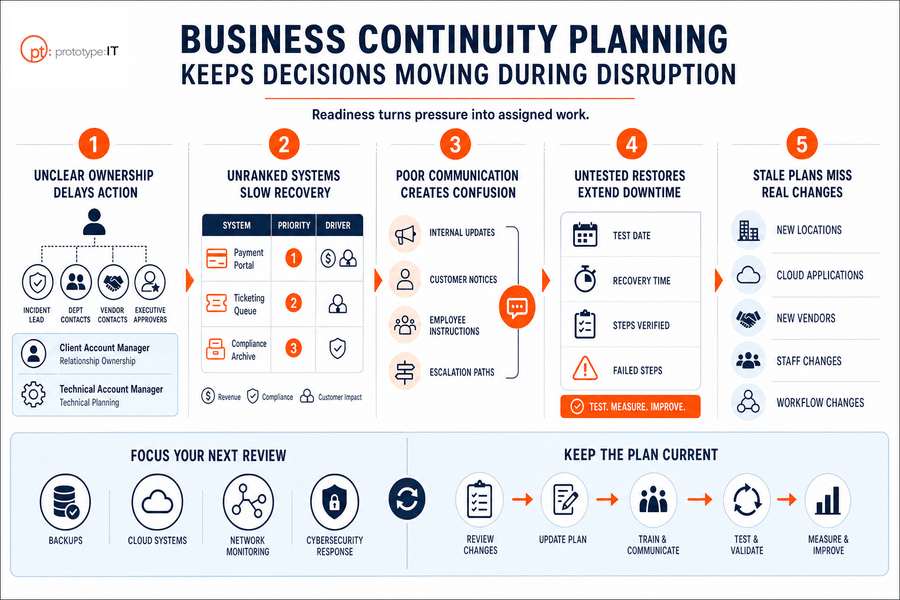
Business Continuity Planning Keeps Decisions Moving During Disruption
When roles are vague, recovery slows and exposure grows through delayed tickets, missed customer updates, duplicate work, and stalled approvals. Downtime can cost enterprise organizations as much as USD 9,000 per minute, which is why Business Continuity Planning belongs with leadership and operations, not only IT. In sensitive industries such as finance and healthcare, downtime can reach as high as USD 5,000,000 per hour, reinforcing the need for assigned decisions before an incident begins.
-
Unclear ownership delays action: Name incident leads, department contacts, vendor contacts, and executive approvers. After onboarding, our dedicated Client Account Manager and dedicated Technical Account Manager help keep relationship ownership, technical planning, account reviews, roadmaps, and budget discussions connected to the recovery plan.
-
Unranked systems slow recovery: Define which systems return first based on revenue, compliance, and customer impact. The payment portal, ticketing queue, and compliance archive do not carry the same urgency.
-
Poor communication creates confusion: Document internal updates, customer notices, employee instructions, and escalation paths before inboxes fill with status requests. If customer data is involved, transparency needs an owner, approval path, and message ready to review.
-
Untested restores extend downtime: Require restore testing, not just backup confirmation alerts. Track test dates, recovery timing, failed steps, and ticket notes showing what changed.
-
Stale plans miss real changes: Update the plan after new locations, cloud applications, vendors, staff changes, or workflow changes. A checklist that ignores last quarter’s software rollout creates avoidable delays.
Readiness turns pressure into assigned work with owners, timelines, and documented handoffs.
Focus your next review on backups, cloud systems, Network Monitoring, and cybersecurity response.
Keep Operations Resilient
Disaster Recovery In Real Operating Conditions
Ransomware, hardware failure, human error, natural events, cloud access issues, ISP outages, and failed network equipment affect departments differently. Finance misses an invoice run, customer support loses ticket history, operations faces dispatch delays, and leadership works from partial information. Start with scheduled actions that fit existing meetings and ticket workflows.
Our true in-house 24×7 helpdesk, Network Monitoring, Managed IT Services, Managed Network Backup Services, and proactive alerting down to the asset component level support practical visibility before small issues become larger outages.
-
Assign system owners: Name a continuity owner and backup owner for each critical system, including the CRM, accounting platform, file storage, firewall, and core cloud applications.
-
Build team checklists: Create recovery checklists for finance, operations, customer support, leadership, and IT so each group knows its first action and escalation path.
-
Test recurring scenarios: Run one restore scenario each quarter or another documented schedule, then record gaps and assign follow-up tickets with due dates.
-
Review technical dependencies: Check ISP redundancy, firewall configuration, endpoint protection, and cloud access controls after major system or location changes.
Build a Recovery Plan That Works
Prototype IT helps align disaster recovery and business continuity planning with your systems, workflows, and response priorities.
Business Continuity Planning For Growth And Change
Plans fail when they do not keep up with hiring, new software, new locations, cloud migrations, vendor changes, compliance requirements, and leadership changes. The DRaaS market is projected to grow from USD 16,112.2 million in 2025 to USD 46,089.9 million by 2032, showing how much attention recovery now receives as operations become more cloud-based. We use defined metrics, team checklists, and prioritization scoring to keep plans aligned with tickets, approvals, customer records, cloud access, vendor handoffs, and recovery timelines. Our customizable managed services, one-invoice, one-vendor support model, in-house project services team, hardware and purchasing support, and structured onboarding process help connect planning to implementation.
Sidebar: Continuity Plan Review Checklist
-
Critical systems list
-
Restore test date
-
Owner names
-
Vendor contacts
-
Communication templates
-
RTO and RPO targets
-
Backup status
-
Cybersecurity scan status
-
Cloud access review
-
Next review date
Turn Your Recovery Plan Into An Operating Habit
Readiness depends on business priorities, named owners, tested restores, communication paths, and regular updates after systems or workflows change. No guesswork.
Prototype IT can help assess risk profiles, review recovery gaps, document team responsibilities, test recovery steps, and align IT systems with business operations through customer-first, accountable, end-to-end IT support with practical guidance, clear ownership, and no long-term lock-in.
If a failed server would block invoice runs tomorrow, use that scenario as the starting point for a no-pressure conversation about what your current plan can prove. Contact us today.
Find Trusted Cybersecurity Services in Texas
Free Network Assessment:
Get In Touch
- ▶ 401 E. Corporate Dr STE 220
Lewisville, TX 75057 - ▶ 600 W. 6th St Suite 485
Fort Worth, TX 76102 - ▶ 13155 Noel Rd Suite 905
Dallas, TX 75240 - Phone: (214) 270-0850
- Web: https://www.prototypeit.net
