
Managed IT vs In House IT: How Growing DFW Teams Choose The Right Support Model
August 20, 2026

Table of Contents
For growing DFW businesses, Managed IT vs. In-House IT is an operational maturity decision. Tickets pile up, after-hours issues wait until morning, cybersecurity expectations rise, and network stability starts affecting invoices, approvals, customer access, and staff productivity.
Thad Siwinski, CEO at Prototype IT, notes: “Choose the model that protects daily operations first, then decide which skills should stay internal and which require deeper coverage.”
Hiring is only part of the equation. Coverage, predictability, and accountability matter just as much, especially when a recent study found 60% of respondents said cybersecurity was the top challenge that led them to work with an MSP.
At Prototype IT, we help evaluate support models around risk, internal capacity, continuity, and control, not generic technology preference.
Managed IT Vs. In-House IT For Growing Operations
The right model depends on workload, risk tolerance, internal skills, and growth pace. A single IT generalist can support a stable office, but growth changes the math when tickets, cloud systems, endpoint security, and new-location planning all compete for the same calendar.
-
Internal business context: In-house IT knows your users, workflows, systems, and onsite quirks, which helps during local support issues.
-
Growth-stage bottlenecks: One person or a small team becomes the checkpoint for tickets, access approvals, maintenance, projects, and security follow-up.
-
Managed support depth: Managed IT adds help desk coverage, network monitoring, endpoint support, cybersecurity services, and predictable monthly fees.
-
Co-managed flexibility: We can work alongside internal IT under your direction, supporting help desk, updates, preventive maintenance, procurement, servers, networking, voice, and cabling without forcing an all-or-nothing model.
This becomes a business-impact decision when delayed tickets affect orders, payroll deadlines, and customer handoffs. Security coverage also needs a realistic staffing plan; Trend found 33% of respondents rely on MDR or MSSP offerings, compared with 27% using rotating schedules and 25% using on-call systems.
Outside capacity is expanding, too: IDC reported that service providers spent $65.6 billion on compute and storage infrastructure in 4Q24, up 103.9% from the prior year.
Key capability areas include help desk support, network monitoring, cybersecurity services, and infrastructure planning.
Managed IT And In-House IT Cost Visibility
Cost control is not just payroll versus service fees. You also pay for downtime, emergency labor, delayed projects, licensing sprawl, vendor management, and security gaps that turn into unplanned work.
-
Ticket backlog and labor capacity: When password resets, laptop issues, and access requests consume the day, higher-value work slips. A predictable support model routes basic tickets without pulling your best internal resource away from planning.
-
After-hours and vacation gaps: If a server alert hits during PTO or a weekend cutover, coverage depends on who is available. Reliable after-hours support keeps urgent issues moving.
-
Cybersecurity ownership and accountability: MFA, endpoint protection, patching, backups, and monitoring need named owners. Managed support creates a documented cadence with clear escalation.
-
Project spikes and expertise: Firewall replacements, cloud migrations, and office moves require planning, testing, rollback steps, and documentation. Tiered technicians and project resources reduce scheduling conflicts.
-
Vendor and procurement complexity: Portals, renewals, invoices, warranties, and hardware quotes create administrative drag. One vendor and one invoice can simplify approvals and budgeting.
Comparing Managed IT With Internal IT Teams
A side-by-side view helps you decide whether to hire, outsource, or combine models without turning the decision into a staffing debate. Focus on coverage, skill mix, risk ownership, and control.
|
In-House IT |
Managed IT Services |
Co-Managed IT |
|---|---|---|
|
Best fit: stable needs, high onsite context |
Best fit: broader coverage and predictable support |
Best fit: internal leadership plus external depth |
|
Coverage model: business hours unless staffed otherwise |
Coverage model: 24/7 help desk, monitoring, remote and onsite support |
Coverage model: shared coverage for tickets, alerts, and projects |
|
Skill breadth: depends on hires |
Skill breadth: Tier 1, 2, and 3 expertise across systems |
Skill breadth: specialist support when internal staff need backup |
|
Cybersecurity coverage: internally assigned |
Cybersecurity coverage: managed security, endpoint, backup, firewall, and monitoring |
Cybersecurity coverage: provider handles defined controls under your oversight |
|
Scalability: hire and train as needs grow |
Scalability: add users, devices, servers, or locations through service plan |
Scalability: expand coverage without replacing internal roles |
|
Business control: direct employee management |
Business control: provider manages agreed services |
Business control: you keep strategy and priorities |
What this looks like in practice. A Dallas office opening a second location may keep its internal IT lead for vendor approvals while our Project Services team handles network design, cabling coordination, firewall setup, and cutover support.
A Fort Worth team adding remote staff may need endpoint configuration, VPN access, and Mac support without slowing new-hire onboarding. You get broader coverage while keeping the same oversight.
Explore Related IT Strategy Guides
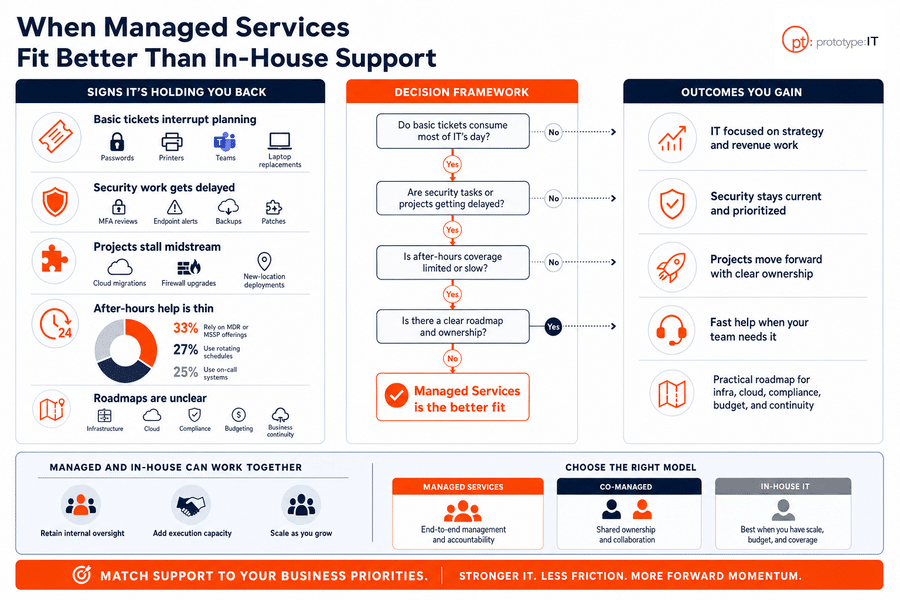
When Managed Services Fit Better Than In-House Support
IT becomes an operational constraint when routine requests delay revenue work. You see it when a sales user waits for CRM access, accounting cannot print checks, or a warehouse scanner ticket stays open because the same IT person also handles backups and patching.
-
Basic tickets interrupt planning: Your internal IT person spends the day on passwords, printers, teams issues, and laptop replacements instead of lifecycle planning.
-
Security work gets delayed: MFA reviews, endpoint alerts, backup checks, and patch approvals lose priority to urgent support requests.
-
Projects stall midstream: Cloud migrations, firewall upgrades, and new-location deployments need planning, testing, documentation, and a clear owner.
-
After-hours help is thin: Employees wait during cutovers, weekend work, or early shipping deadlines. Our in-house Technician on Duty system and non-outsourced help desk give urgent issues a defined escalation path.
-
Roadmaps are unclear: Leadership lacks a practical plan for infrastructure, cloud, compliance, budgeting, and business continuity. If you need strategic consulting beyond day-to-day support, vCIO services should be scoped separately.
Managed IT and In-House IT can also work together when your team needs retained oversight with stronger execution capacity.
Choose the Right IT Support Model
Compare managed, in-house, and co-managed options with Prototype IT so your DFW team can reduce gaps and support growth with confidence.
How To Choose Between Managed IT Or In-House IT
Changing support models affects people, workflows, approvals, budgets, and institutional knowledge. Start with what is happening in your ticket system, device inventory, backup reports, and project list before assigning ownership. It should not be reduced to payroll math; even in software development outsourcing, 63% cite cost reduction as the most common driver, but outsourcing decisions also depend on risk, capacity, timing, and execution quality.
-
Map recurring tickets: Sort requests by category, urgency, department, system, and repeat user impact.
-
Identify coverage gaps: Document after-hours incidents, vacation conflicts, single-person dependencies, and systems only one employee understands.
-
Review security responsibilities: Confirm owners for MFA, backup testing, endpoint protection, patching, firewall alerts, and monitoring.
-
Compare project demand: Match cloud, server, network, phone, and compliance projects against internal hours available.
-
Assign the right functions: Keep strategic approvals internal while an MSP supports help desk, monitoring, maintenance, procurement, or project execution.
Evaluate service structure, onboarding, SLA expectations, escalation paths, and account management before choosing. Our onboarding includes a kickoff call, an assigned certified project manager, and environment documentation so agents, tools, and support details are ready by the selected service start date when the environment allows.
After onboarding, your dedicated Client Success Manager serves as the relationship owner and client champion, while your dedicated Technical Account Manager supports technical insight, roadmaps, account reviews, budgeting, and planning.
A Clearer Path For Your IT Support Model
Your best support model depends on coverage needs, internal capacity, cybersecurity risk, project demand, and how much control you want to retain.
Prototype IT can help you assess your current setup through a no-pressure conversation, with flexible Managed IT Services or Co-Managed IT options, an in-house 24/7 help desk, cybersecurity coverage at no additional cost for managed services clients, and no long-term lock-in beyond 30-day written notice.
If ticket backlogs, after-hours gaps, or security ownership questions are affecting invoices, approvals, or customer access, contact us and we will help you map the next practical step.
Explore Managed IT Services Near You
Free Network Assessment:
Get In Touch
- ▶ 401 E. Corporate Dr STE 220
Lewisville, TX 75057 - ▶ 600 W. 6th St Suite 485
Fort Worth, TX 76102 - ▶ 13155 Noel Rd Suite 905
Dallas, TX 75240 - Phone: (214) 270-0850
- Web: https://www.prototypeit.net
