
How PCI Security Awareness Training Brings Compliance Into Everyday Work
March 2, 2026



74% of data breaches involve human error, emphasizing the critical role of staff awareness in protecting sensitive information.
As Thad Siwinski, CEO of Prototype IT, puts it, “Employee knowledge is the first firewall of a business. Awareness transforms risk into a controlled process.”
Protecting payment card data is no longer just a technical task. Every transaction, email, and system access relies on how your employees behave. PCI security awareness training connects compliance requirements directly to daily actions. Without it, even the most sophisticated systems fail when human error occurs.
A robust training program empowers staff to:
-
Identify Risks: Spot suspicious activity before it escalates.
-
Respond to Threats: Apply practical steps to contain and report incidents.
-
Maintain Compliance: Align daily actions with PCI DSS requirements.
-
Build Accountability: Contribute to a culture where security is everyone’s responsibility.
This blog shows why training matters, how it works, and how to embed it into operations for sustainable protection.
Make Human Error a Thing of the Past
Build a security-first culture with PCI security awareness training that integrates seamlessly into daily workflows.
The Goal of PCI Security Awareness Training
Training isn’t just compliance paperwork. Its purpose is to translate PCI DSS rules into actionable behaviors. When employees understand why procedures exist, they avoid mistakes that could compromise cardholder data. KnowBe4 research finds that smart security training slashes the chance of a breach by 65%
PCI awareness training helps you:
-
Identify Weak Points in Workflow: Staff learn correct procedures for handling transactions, storage, and communication.
-
Reduce Accidental Exposure: Programs highlight common threats like phishing, weak passwords, and unsecured devices.
-
Align With Audit Expectations: Employees trained in PCI DSS procedures contribute to smoother compliance assessments and minimize remediation time.
Every team member becomes a line of defense. The knowledge they apply in daily operations reduces the risk of human error and strengthens your organization’s overall cybersecurity posture.
This leads directly into understanding how to meet formal requirements without treating training like a checkbox.
Meeting the PCI Training Requirement Without Treating It Like a Checkbox
PCI DSS Requirement 12.6 mandates that organizations provide ongoing training programs to all staff handling cardholder data. This training is not optional. Annual sessions, onboarding education, and regular updates create a foundation for informed decisions.
Key elements include:
-
Annual Training: Employees attend structured courses covering PCI DSS standards, new threats, and practical procedures.
-
Acknowledgment Records: Teams confirm their understanding of policies, creating accountability and documentation for audits.
-
Continuous Updates: As threat landscapes evolve, employees receive timely information on security alerts, process changes, and compliance expectations.
When treated as an operational practice rather than a formality, PCI training ensures employees actively participate in protecting sensitive data. It embeds knowledge into workflows, making compliance a living part of your organization.
How PCI Employee Training Builds a Security Mindset Across Departments
Data security isn’t confined to IT teams. Finance, operations, customer service, and leadership all interact with payment information. PCI employee training spreads responsibility across your organization.
Consider these benefits:
-
Role‑Based Accountability: Each department follows procedures aligned with PCI DSS requirements, understanding how their decisions affect overall security.
-
Cross‑Functional Awareness: Teams identify risks in their workflows and collaborate on mitigation, closing weak points before they become issues.
-
Improved Reporting: Employees recognize suspicious activities and report anomalies immediately, supporting incident response.
When all teams are aligned, your organization becomes a network of informed defenders, not isolated silos. This approach sets the stage for the practical implementation of PCI security training.
What Effective PCI Security Training Looks Like in Practice
Implementing PCI security training successfully requires realistic, engaging programs that employees can apply. Examples include:
-
Phishing Simulations: Test how employees respond to simulated attacks, reinforcing vigilance.
-
Scenario‑Based Learning: Practice responses to data mishandling, suspicious activity, or process failures.
-
Monthly Awareness Themes: Short campaigns on password security, device handling, or email vigilance maintain continuous learning.
-
Leadership Engagement: Managers demonstrate best practices, emphasizing that security is a shared responsibility.
Effective training programs are repeated, measurable, and connected to daily operations. Employees retain knowledge when they see relevance to their tasks. This directly leads to embedding awareness into daily workflows and strengthening organizational resilience.
|
More articles you might like: |
Connecting PCI Training to Daily Operational Processes
PCI training is effective when it moves beyond annual sessions. Embedding practices into workflows ensures compliance and protects cardholder data.
Practical steps include:
-
Secure Transaction Handling: Employees consistently follow defined protocols when processing payments.
-
Authentication & Access Control: Staff use secure credentials, multi‑factor authentication, and follow access policies.
-
Reporting Procedures: Employees report anomalies, potential threats, and system irregularities immediately.
-
Integration With Onboarding: New staff learn proper security habits from day one, reducing exposure risk.
When training aligns with operational processes, it shifts from a compliance task to a practical defense strategy. This naturally supports PCI compliance certification training goals.
How PCI Compliance Certification Training Supports Audit Readiness
52% of security breaches start with a human misstep, revealing the critical role of employee vigilance. Structured education aligns your teams with regulatory expectations.
PCI compliance certification training:
-
Prepares Employees for Assessor Interactions: Staff gain a clear understanding of PCI DSS requirements.
-
Reduces Remediation Cycles: Prevents repeated errors by embedding correct practices early.
-
Creates Documented Proof of Knowledge: Demonstrates organizational diligence to auditors.
Certification training complements operational awareness, bridging the gap between theory and real‑world practice. It ensures employees are not only aware but capable of applying rules effectively.
Building a Sustainable PCI Awareness Training Program Instead of One‑Time Instruction
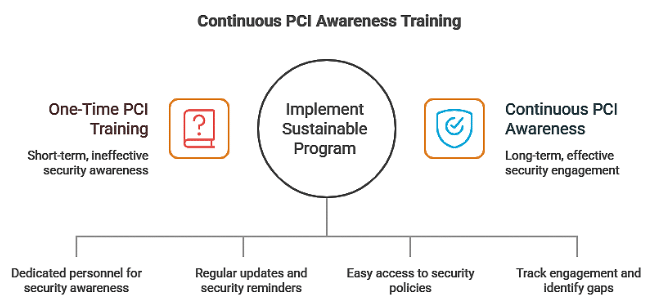
Long‑term protection requires continuous engagement. PCI awareness training is not a one‑off activity.
Effective programs:
-
Assign Security Awareness Teams: Dedicated groups develop, deliver, and maintain training programs.
-
Run Communication Campaigns: Regular emails, newsletters, and intranet posts keep employees informed.
-
Provide Accessible Documentation: Policies, guidelines, and incident reports remain easy to access.
-
Measure Participation: Metrics on engagement, comprehension, and behavioral change allow improvement and accountability.
Continuous programs maintain vigilance, instill habits, and reduce organizational risk. They create a culture where staff act consciously to protect sensitive data, reinforcing the benefits of PCI awareness training.
The Business Impact of PCI Security Awareness Training Beyond Compliance
Awareness training extends beyond compliance. Employees who understand risks:
-
Reduce Operational Disruptions: Respond quickly to threats, minimizing downtime.
-
Strengthen Customer Trust: Demonstrate responsible handling of sensitive data.
-
Align Compliance With Business Goals: Reduce financial and reputational exposure by embedding security into operations.
When staff members act as informed defenders, your organization experiences fewer incidents, faster resolution times, and stronger operational resilience. PCI security awareness training is therefore a strategic investment, not a regulatory burden.
Key Elements of Effective PCI Security Awareness Programs
The following table highlights aspects of awareness programs not discussed in‑depth in previous sections. It provides actionable value, showing exactly what to implement for sustainable employee engagement.
|
Program Component |
Practical Steps |
Expected Outcome |
|
Phishing Simulations |
Run quarterly realistic simulations; review outcomes with staff |
Employees recognize and report suspicious emails |
|
Scenario‑Based Training |
Assign role‑specific incident scenarios |
Staff apply PCI rules in real situations |
|
Monthly Awareness Themes |
Focus on one topic per month, like password security |
Continuous reinforcement of key behaviors |
|
Leadership Engagement |
Managers model best practices in meetings and email |
Cultural adoption of secure practices |
|
Metrics & Feedback |
Track attendance, completion, and comprehension |
Measurable improvement in employee behavior |
These elements ensure the training program grows with your organization, addressing evolving threats and reinforcing staff accountability.
Protect Cardholder Data with Prototype IT
PCI security awareness training is essential for your employees, processes, and compliance posture. By connecting training to daily operations, ongoing reinforcement, and practical scenarios, you ensure staff members act as active defenders of sensitive data.
Prototype IT supports over 6,700 end users with:
-
24×7 Helpdesk Support: Always‑on assistance to resolve issues quickly.
-
82% First‑Time Resolution Rate: Most problems solved immediately, minimizing disruption.
-
Guidance & Hands‑On Protection: Structured training paired with operational support.
-
Enterprise‑Grade Experience: Over two decades of expertise in compliance and IT resilience.
Contact us today to implement effective PCI security awareness Training, safeguard your cardholder data, and strengthen your compliance and operational resilience. Schedule a consultation to build a program tailored to your organization’s unique needs.
|
Find Trusted Cybersecurity Services in Texas |
Free Network Assessment:
Get In Touch
- ▶ 401 E. Corporate Dr STE 220
Lewisville, TX 75057 - ▶ 600 W. 6th St Suite 485
Fort Worth, TX 76102 - ▶ 13155 Noel Rd Suite 905
Dallas, TX 75240 - Phone: (214) 270-0850
- Web: https://www.prototypeit.net
