
Don’t Let Hackers Win: 7 Benefits of Cyber Security Training You Can’t Ignore
February 15, 2025



According to CloudSecureTech, 60% of small businesses that fall victim to a cyberattack close their doors within six months.
That staggering number speaks volumes about the risks you face daily. And yet, many businesses still treat cybersecurity as an afterthought. If your employees aren’t prepared, you’re not just flirting with data loss—you’re gambling with your entire operation.
“Cyber threats adapt at lightning speed—so your training must keep pace.” – Thad Siwinski, CEO of Prototype IT.
In the sections below, you’ll explore the importance and benefits of cybersecurity training and how the right strategies can bolster your defenses and secure your future.
Why You Should Care about Cybersecurity Training
The human element continues to drive breaches. This year 82% of breaches involved the human element. Whether it is the Use of stolen credentials, Phishing, Misuse, or simply an Error, people continue to play a very large role in incidents and breaches.
When you invest in education, you invest in resilience. One of the biggest benefits of cyber security training is turning potential vulnerabilities—your employees—into proactive defenders. If your staff can recognize malicious links or suspicious emails, you reduce your attack surface drastically. You also signal to your clients and partners that you take their data seriously, which can set you apart from competitors who treat security as an afterthought.
Teaching your team how to maintain safe passwords, identify phishing attempts, and use secure communication channels isn’t rocket science. It’s practical knowledge that any motivated employee can learn—and then apply every day.
Hot Take: Skimping on training might save money today, but it could cost your entire business tomorrow. A well-informed workforce is your first, and often your best, line of defense.
Why Smaller Businesses Are Prime Targets
You might assume hackers will skip over your business in favor of bigger fish. In reality, cybercriminals know smaller organizations often lack the resources for top-tier security. Many small enterprises juggle multiple priorities with lean budgets, leaving critical systems under-defended. A study released in June 2023 found that 61% of SMBs (small and medium businesses) in the US and UK were successfully hit by a cyberattack in the past year. Attackers exploit outdated software, untrained staff, and the common “it won’t happen to us” mindset to infiltrate networks—often undetected for weeks or even months.
Raising the Bar with Cyber Awareness Training
Think of cyber awareness training as your everyday security compass: it points employees in the right direction whenever they come across something suspicious. This training goes beyond formal presentations and corporate jargon. It involves hands-on exercises, like simulated phishing drills, that gauge how your team reacts in real situations.
The Cybersecurity & Infrastructure Security Agency (CISA) recommends a layered approach. Employees should understand not just the “what” of threats but also the “how,” like how ransomware spreads through a single click or how social engineering can manipulate even cautious staff members. Over time, continuous cyber awareness fosters a culture where everyone—top to bottom—feels responsible for guarding company data.
Hot Take: If you can make employees as vigilant about online threats as they are about personal safety, you can dramatically shrink your business’s attack surface.
The True Cost of Neglecting Cyber Awareness
A single phishing email can unleash catastrophic results. Financial losses are just the tip of the iceberg; a data breach can erode customer trust, attract regulatory penalties, and hamstring your day-to-day operations. Even a short period of downtime can cost thousands—or millions—in lost productivity and sales. Check out IBM’s Cost of a Data Breach Report to see how organizations spend an average of $4.88 million dealing with breaches. Beyond monetary damage, think about the toll on employee morale and public relations. Not only do you risk losing the confidence of existing clients, but prospective clients may take their business elsewhere if they sense you’re not prioritizing cybersecurity.
Don’t Let Human Error Be Your Weakest LinkPartner with cybersecurity experts who will train and equip your team |
Top 7 Benefits of Cyber Security Training for Your Organization
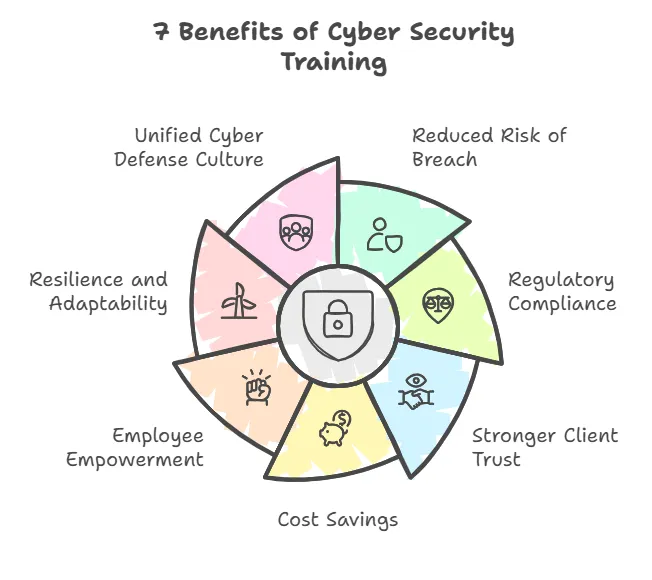
Imagine that every single member of your team becomes a capable defender of your business’s digital borders. That’s what robust cyber awareness training delivers. Instead of relying solely on firewalls and antivirus software, you empower employees to spot and stop threats before they cause damage. The upside isn’t just prevention of attacks; you also strengthen internal culture, enhance public trust, and avoid costly pitfalls. Below are seven transformative benefits your organization gains when you prioritize continuous and comprehensive cyber security training.
- Reduced Risk of Breach
By educating employees on threat recognition and secure online behavior, you dramatically lower the chance of an attacker successfully infiltrating your systems. Trained staff become a human firewall—the first line of defense when suspicious links or requests pop up. - Regulatory Compliance
In industries where compliance is paramount—such as healthcare (HIPAA) or finance (PCI DSS)—there’s no room for error. Proper instruction on how to handle sensitive data not only keeps regulators at bay but also protects you from punitive fines and legal repercussions. - Stronger Client Trust
Clients now expect robust data protection measures from anyone they do business with. Showcasing a trained workforce reassures existing clients and can attract new opportunities. It signals you’re serious about safeguarding information and maintaining a reputable brand image. - Cost Savings
Investing in security awareness training is often significantly cheaper than recovering from a major breach. Cutting-edge solutions and ongoing employee education may seem costly at first, but the financial hit you avoid can be tenfold—if not more—than your initial outlay. - Employee Empowerment
Boosting staff knowledge fosters a sense of ownership. When each individual knows the critical role they play in keeping data safe, they’re more vigilant in spotting suspicious activities. An empowered team is more proactive and less likely to fall for social engineering tricks. - Resilience and Adaptability
Cyber threats evolve at breakneck speed, and a static approach to security simply won’t cut it. Ongoing education ensures your team can adapt quickly to new forms of attacks. This resilience helps you pivot when hackers change tactics, keeping you one step ahead. - Unified Cyber Defense Culture
The importance of cyber security awareness training for employees lies in fostering a culture where everyone is on high alert. Rather than relying solely on IT, you create a unified front: management, frontline workers, and support staff collaborating to identify and mitigate threats.
By weaving cyber security training into the fabric of your daily operations, you gain far more than a checklist item for compliance. You develop a risk-aware culture, protect crucial data, and foster trust with clients and partners.
Actionable Steps for Effective Cyber Awareness Training
- Identify Current Gaps: Conduct a quick survey or test to assess your team’s baseline knowledge. Use tools like KnowBe4 for simulated phishing exercises to gauge vulnerability.
- Use Diverse Training Formats: Combine engaging e-learning modules, live workshops, and real-time phishing simulations. This multi-pronged approach caters to different learning styles.
- Schedule Regular Refreshers: Cyberthreats don’t stand still, and neither should your training. Monthly or quarterly updates keep lessons fresh in everyone’s mind.
- Track Progress and Celebrate Wins: Recognize departments or individuals who consistently perform well in simulated tests. Positive reinforcement amplifies training success.
Overcoming Employee Resistance
Training can sometimes feel like a chore, especially if your team doesn’t see how it directly benefits them. Break through this barrier by:
- Framing Training as Essential, Not Optional: Explain why security training is important—to safeguard both company data and personal information.
- Using Gamification: Turn tasks like phishing simulations into friendly competitions, complete with small rewards for top performers.
- Leading by Example: When leadership takes an active, enthusiastic role, employees follow suit. Demonstrate you’re willing to invest resources and time in their security skillset. For more tips on engaging employees in security initiatives, check out Forbes’ cybersecurity engagement insights.
| Learn More About Avoiding Data Loss |
Building a Long-Term Security Culture
Robust cyber security awareness training for employees isn’t a one-and-done task. It requires:
- Continuous Improvement: Regularly review and update your training materials based on emerging threats or internal incidents.
- Open Communication: Encourage staff to report suspicious emails or activity without fear of reprimand. A swift response can stop an attack before it spreads.
- Adopting Best Practices: Align your training with frameworks from organizations like NIST (National Institute of Standards and Technology). This not only strengthens your security stance but also instills confidence in stakeholders.
Adding consistent value through updates, Q&A sessions, and real-world practice ensures that a what is the purpose of security awareness training question never goes unanswered. You want a culture in which everyone sees cybersecurity as part of their daily responsibilities.
Key Components of an Effective Cybersecurity Awareness Program
| Component | Why It Matters | How to Implement |
| Policies & Guidelines | Sets the rules for acceptable behavior and data handling | Draft clear policies, distribute them company-wide, and review yearly |
| Simulated Attacks | Helps employees recognize real threats in a risk-free environment | Conduct phishing tests regularly using services like KnowBe4 or similar |
| Ongoing Training & Refreshers | Keeps knowledge up-to-date against new attack vectors | Schedule monthly micro-learning sessions or quarterly deep dives to reinforce essential habits |
| Reporting Mechanisms | Encourages prompt action on suspicious activity | Provide employees with a direct channel (e.g., dedicated email or internal portal) to flag potential threats |
| Leadership Endorsement | Boosts engagement and highlights the program’s importance | Have executives participate in training and communicate its value in team meetings |
Protect Your Future with Prototype
In this post, you explored the benefits and importance of cybersecurity training, from mitigating risks of data breaches to boosting client trust and ensuring compliance. You learned how a well-executed program can empower employees, save costs, and help you stay resilient against evolving threats. Cybersecurity is no longer an afterthought—it’s a critical component of modern business success. That’s where Prototype IT comes in. As a leading Managed Service Provider (MSP), they offer comprehensive cyber security solutions tailored to your unique needs. Contact Prototype IT today to learn more about strengthening your security posture and to schedule a personalized consultation.
| Ask Our Texas-Based Team How You Can Prevent Data Breaches | ||
| Dallas | Lewisville | Fort Worth |
Free Network Assessment:
Get In Touch
- ▶ 401 E. Corporate Dr STE 220
Lewisville, TX 75057 - ▶ 600 W. 6th St Suite 485
Fort Worth, TX 76102 - ▶ 13155 Noel Rd Suite 905
Dallas, TX 75240 - Phone: (214) 270-0850
- Web: https://www.prototypeit.net
