
Enterprise Data Preparation For AI: Turn Fragmented Data Into Operational Readiness
September 23, 2026



Table of Contents
-
Enterprise Data Preparation For AI Starts With Operational Data Ownership
-
How To Clean Data For Machine Learning Across Business Systems
-
Enterprise Data Preparation For Generative AI Needs Secure Access Controls
-
Enterprise Data Preparation For AI Services Requires Repeatable Infrastructure
-
Clean Data For Machine Learning Improves Customer And Approval Workflows
-
Enterprise Product Data Preparation For AI Agents Depends On Governed Catalogs
-
How To Clean Data In Python For Machine Learning Without Losing Business Context
Enterprise data preparation for AI is an operational readiness issue. If customer records live in one CRM, invoices in accounting, approvals in email, tickets in a service platform, and product files on unmanaged shares, AI inherits the confusion.
That matters because 78% of enterprises are actively using AI, while only 41% of enterprise data is usable by AI on average. Knowing how to clean data for machine learning starts with secure systems, clean workflows, centralized documentation, and accountable support.
Thad Siwinski, CEO at Prototype IT, notes: “Prepare the workflow before you prepare the model, because AI will expose every duplicate record, unclear approval path, and undocumented exception already slowing the business.”
Enterprise Data Preparation For AI Starts With Operational Data Ownership
Data ownership matters because records sit across CRM, accounting, ticketing, document management, cloud storage, and line-of-business apps. With 81% of CDOs bringing AI to data rather than centralizing data for AI, each source needs a named owner, change process, and escalation path.
Prototype IT’s model pairs a dedicated Client Account Manager with a dedicated Technical Account Manager to keep support conversations tied to systems, decisions, account reviews, and roadmaps.
-
Define record meaning: Sales owns customer status, finance owns billing terms, and operations owns fulfillment fields.
-
Approve field changes: Require approval before edits affect reports, invoices, tickets, or customer records.
-
Resolve duplicate records: Merge contacts, vendors, and products before duplicates spread.
-
Monitor data quality: Review failed imports, rejected invoices, stale tickets, and sync errors.
-
Document exceptions: Capture approved workarounds before AI repeats them at scale.
How To Clean Data For Machine Learning Across Business Systems
Cleaning data is a workflow discipline. People decide what is correct, systems enforce it, approvals confirm it, and checks keep it from drifting. That matters when only 26% of CDOs are confident their data capabilities can support new AI-enabled revenue streams. The business impact shows up as delayed approvals, wrong customer records, unreliable reporting, and files that cannot be trusted from cloud or mobile access points.
-
Remove duplicates at source: Merge duplicate customers, vendors, and tickets before reporting or training begins.
-
Standardize naming across systems: Align product names, account types, departments, and locations.
-
Resolve missing required fields: Flag empty tax IDs, contract dates, mobile numbers, and approver names.
-
Review permissions and rules: Validate access, cloud folders, mobile endpoints, and business logic before data moves.
|
Control Point |
Business-System Example |
Owner or Approval |
Failure Mode Prevented |
|---|---|---|---|
|
Customer identity match |
Compare Salesforce account IDs, ERP customer numbers, and billing contact emails before model training |
Revenue Operations Manager approves merged records |
Duplicate customer profiles causing incorrect churn scores or account recommendations |
|
Document metadata check |
Verify SharePoint contract files include client name, effective date, renewal term, and signed status |
Legal Operations reviews exceptions |
AI extracting obligations from outdated drafts or unsigned agreements |
|
Access-rights validation |
Confirm HR, finance, and mobile CRM datasets follow Microsoft Entra ID group permissions |
IT Security Lead signs off before cloud sync |
Restricted payroll or customer data appearing in unauthorized analytics workspaces |
|
Workflow handoff test |
Run sample purchase orders from NetSuite through Teams approval notifications and archive storage |
Procurement Director confirms routing logic |
Delayed approvals caused by missing approvers, broken alerts, or mismatched vendor records |
Enterprise Data Preparation For Generative AI Needs Secure Access Controls
Employees use cloud apps, company-specific applications, and mobile work email throughout the day. During enterprise data preparation for generative AI, that convenience needs guardrails because high-risk prompt activity impacted 90% of organizations using GenAI regularly, and 15 percent of enterprise AI prompts contained potentially sensitive information.
Field staff accessing client files, finance teams approving invoices, and service teams searching prior tickets all need fast access. They also need clear limits on what can be copied, summarized, uploaded, or shared from a mobile device.
The right control set supports work without slowing every request.
Secure and replicable configurations, centralized monitoring through a single pane of glass, MFA, endpoint protection, mobile device security, and cloud security help enforce those limits across users, devices, applications, and locations.
Keep Building AI Readiness
-
AI Appreciation Day: A Practical AI Readiness Check For DFW Businesses
-
Microsoft Intune For Businesses: Secure Hybrid Work Without Slowing Teams Down
-
Managed IT vs In House IT: How Growing DFW Teams Choose The Right Support Model
-
How PCI Security Awareness Training Brings Compliance Into Everyday Work
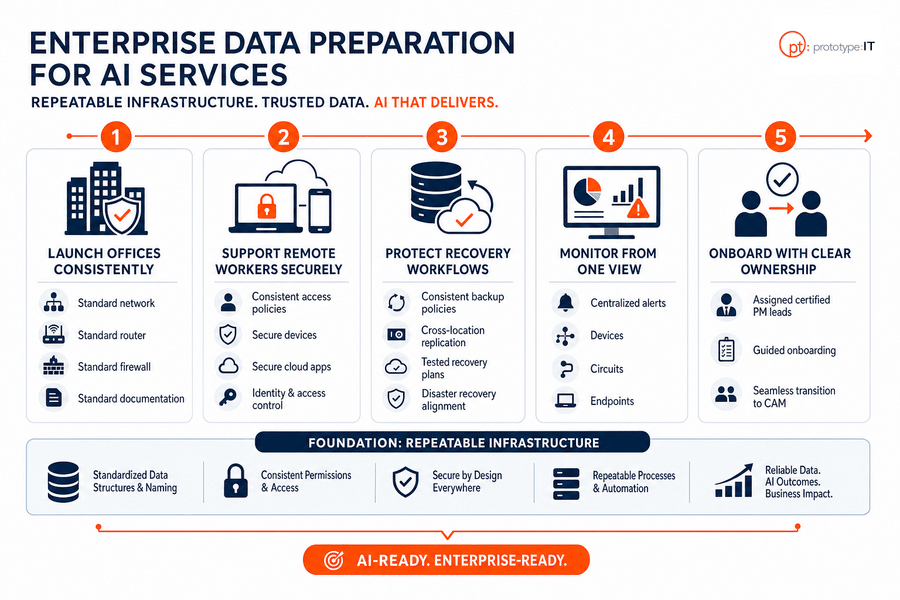
Enterprise Data Preparation For AI Services Requires Repeatable Infrastructure
AI projects stall when every office, department, or remote team uses different configurations, naming structures, permissions, and backup practices.
Enterprise data preparation for AI services works better when infrastructure is repeatable, especially since 78% of enterprises are actively using AI and only 26% of CDOs trust their data capabilities for AI-enabled revenue.
-
Launch offices consistently: Use standard network, router, firewall, and documentation patterns.
-
Support remote workers securely: Apply the same access rules to laptops, phones, and cloud apps.
-
Protect recovery workflows: Align backup and disaster recovery across locations.
-
Monitor from one view: Centralized alerts reduce missed device, circuit, and endpoint issues.
-
Onboard with clear ownership: Prototype IT assigns a certified PM as the primary POC through onboarding, then transitions ownership to the assigned CAM.
Clean Data For Machine Learning Improves Customer And Approval Workflows
A customer calls about an open order, but the CRM shows an old address, the ticketing system has a different contact, and finance is waiting on an invoice approval buried in email. Clean data for machine learning improves the workflows your teams already depend on, especially as AI-led processes rose from 9% in 2023 to 16% in 2024.
-
Customer response improves: Unified communications and CRM data reduce system-hopping and repeated questions.
-
Invoices move faster: Correct vendor, purchase order, and approver fields reduce rework.
-
Tickets route accurately: Clean categories send issues to the right support queue.
-
Products stay consistent: Product, inventory, and service records use the same naming structure.
-
Support fits operations: Customizable support models match cloud tools and workflows to each client environment.
Prepare Your Data for AI Readiness
Fragmented systems slow AI adoption. Prototype IT helps align data, workflows, access, and infrastructure for operational readiness.
Enterprise Product Data Preparation For AI Agents Depends On Governed Catalogs
Enterprise product data preparation for AI agents requires governed catalogs before those tools assist users or automate a workflow. That includes product, service, pricing, policy, customer, and support data, especially as over 50% of organizations have begun deploying or plan to deploy AI agents. Human approval still matters.
Practical next steps:
-
Create approved catalogs: Define one source for pricing, SKUs, service terms, and policies.
-
Map human approvals: Require review before refunds, discounts, account changes, or policy exceptions.
-
Apply security policies: Limit files, folders, and records by role and business need.
-
Use DLP controls: Prevent sensitive data from leaving approved systems.
-
Inventory connected systems: Document CRM, ERP, ticketing, cloud storage, endpoints, and integrations.
How To Clean Data In Python For Machine Learning Without Losing Business Context
Python scripts can identify duplicates, normalize dates, flag missing fields, and validate records. The value comes when business owners define what “correct” means for an invoice, ticket priority, customer status, or product record. Knowing how to clean data in Python for machine learning should support operational decisions, not replace them.
-
Define accepted values: Agree on valid statuses, regions, departments, and product categories.
-
Flag exceptions early: Route missing approvers or unmatched vendors to the right owner.
-
Validate before automation: Test outputs against finance, service, and customer workflows.
-
Preserve business context: Keep notes, approval history, and source-system references.
If you are preparing systems, workflows, users, and data for AI initiatives, contact Prototype IT. We combine an in-house Project Services team, true in-house 24×7 helpdesk, and cybersecurity coverage for managed services clients to support AI readiness across the records, approvals, tickets, invoices, and cloud tools your teams use every day.
Prototype IT also offers no long-term binding support contracts and no lock-in, with customizable support options based on each client’s environment and 30-day written notice for termination.
Explore IT Consulting Services Near You
Free Network Assessment:
Get In Touch
- ▶ 401 E. Corporate Dr STE 220
Lewisville, TX 75057 - ▶ 600 W. 6th St Suite 485
Fort Worth, TX 76102 - ▶ 13155 Noel Rd Suite 905
Dallas, TX 75240 - Phone: (214) 270-0850
- Web: https://www.prototypeit.net
