
Information Security Strategies That Keep Cyber Threats At Bay
August 18, 2025



The pressure on businesses to protect their data and IT systems is mounting. Why? Cyber threats are increasing and becoming more sophisticated, regulations are tightening, and downtime costs are ballooning.
Without a tailored security strategy, your business is exposed, and not just to data breaches, but to reputational damage and operational paralysis. Last year alone, cybercrime inflicted over $16 billion in losses worldwide, according to the FBI. That’s a wake-up call.
As Thad Siwinski, CEO of Prototype IT, puts it: “Security isn’t about chasing perfection, it’s about building momentum with purpose. Every business needs a strategy that’s real, adaptable, and ready to evolve.”
In this blog, you’ll learn how to craft a focused, effective information security strategy that not only protects your business but empowers it to grow confidently.
Fix the Gaps in Your Current Strategy!Work with a team that helps you secure systems, pass audits, and stay productive under pressure. |
How a Strong Information Security Strategy Helps Your Business Scale
Having a good security plan doesn’t add unnecessary complexities or slow you down. It helps your team work smarter, identify what to do when security issues arise, and keeps your business ready for growth. Additionally, it helps:
- Strengthen cyber resilience: You can’t stop every attack, but you can make your systems stronger. When your plan includes fast response times and clear processes, your business can recover quickly from threats and incidents.
- Align IT with business outcomes: Security isn’t just an IT job. Your security plan should support business goals such as customer trust, uptime, and fast service delivery.
- Reduce operational disruptions: With smart access controls, regular testing, and trained staff, you’ll face fewer interruptions. This means fewer delays and less lost revenue.
- Avoid compliance penalties and reputational damage: Failing audits or exposing sensitive data can cause fines and loss of trust. A solid plan ensures you meet requirements and protect your name.
Key Components of a Modern Information Security Strategy
Each part of your information security plan should support daily operations and reduce your biggest risks. Below are five important parts, along with one practical information security strategy example under each.
Asset Classification and Prioritization
Not all systems or data are equally important. Group your assets by risk level: high, medium, or low, and focus your efforts where the impact of a failure would be worst.
Example: A financial firm tags its payment system as high-risk. They build 24/7 monitoring around it, while applying lighter controls to public marketing assets.
Threat Modeling and Risk Assessments
Figure out how someone could attack your systems and where your weak points are. Do this at least twice a year. With more than 28,000 new vulnerabilities discovered in 2023 alone, threat exposure is fast-changing. Regular risk assessments help you keep up.
Example: One manufacturer realizes that remote desktop access is its biggest threat vector and restricts it to key personnel only.
Access Controls and Policy Enforcement
Limit who can access what, and when. Apply the principle of least privilege: only give access when it’s needed.
Example: A legal firm restricts sensitive case files to only the assigned lawyer and their assistant, reducing accidental exposure significantly.
Employee Training with Measurable Outcomes
Your team is part of your defense, but without the right education, they can become your biggest risk. They require regular training to spot cyber risks such as phishing and understand internal rules.
Example: A healthcare provider reduced password-related issues by 75% after switching to monthly 10-minute microlearning sessions.
Proactive Incident Response
Build a to-do checklist when things go wrong. Include steps like who to contact, how to isolate systems, and how to report incidents. Despite its importance, over 77% of organizations still don’t have an incident response plan, which increases recovery times and costs after an attack.
Example: A retailer’s playbook allowed a business to detect and shut down a credential-stuffing attack in under 30 minutes, with no data lost.
Challenges When Building an Information Security Strategy Plan
Even with the best goals, implementing your plan comes with real barriers. These are common blockers and how they affect your progress.
- Limited budgets and rising costs: Security tools and staff training cost money. In tight markets, leaders may want to delay spending. That puts long-term safety at risk.
- Internal resistance or lack of engagement: Your staff may see new rules as extra work. If your plan doesn’t connect to their daily tasks, they’ll ignore it or push back.
- Legacy infrastructure: Old systems are hard to secure. They may not support modern authentication or logging, and patching them can break workflows.
- Regulatory pressure: Rules such as NIS2 and ISO 27001 demand more reporting and audits. You’ll need both technical updates and administrative resources to comply.
- Misalignment between IT and business goals: If your security plan doesn’t help business teams do their work, they’ll see it as a blocker, not a support system.
| Learn More About Avoiding Data Loss |
How to Build an Information Security Strategy Plan That Works
You don’t need a massive budget to succeed. What you need is a clear set of steps and tools that work for your company’s size and sector.
- Set measurable objectives: Define what success looks like. Examples include reducing phishing clicks by 50% or meeting SOC 2 audit deadlines on time.
- Map out compliance timelines: List out the frameworks that apply to you, such as ISO 27001, HIPAA, or NIS2, and note the dates when changes or audits are due.
- Implement realistic and enforceable security policies: Write policies that your team can follow. Use plain language. Assign policy owners and add a way to track compliance.
- Leverage external consultants or tools: Where internal resources fall short, don’t overload your team. Bring in support for tasks such as audits, pen testing, or risk modeling.
- Adopt automation to cover high-risk gaps: Look for simple tools that automate repetitive security tasks such as log monitoring or patch deployment. These reduce human error.
Continuous Improvement and Long-Term Maintenance
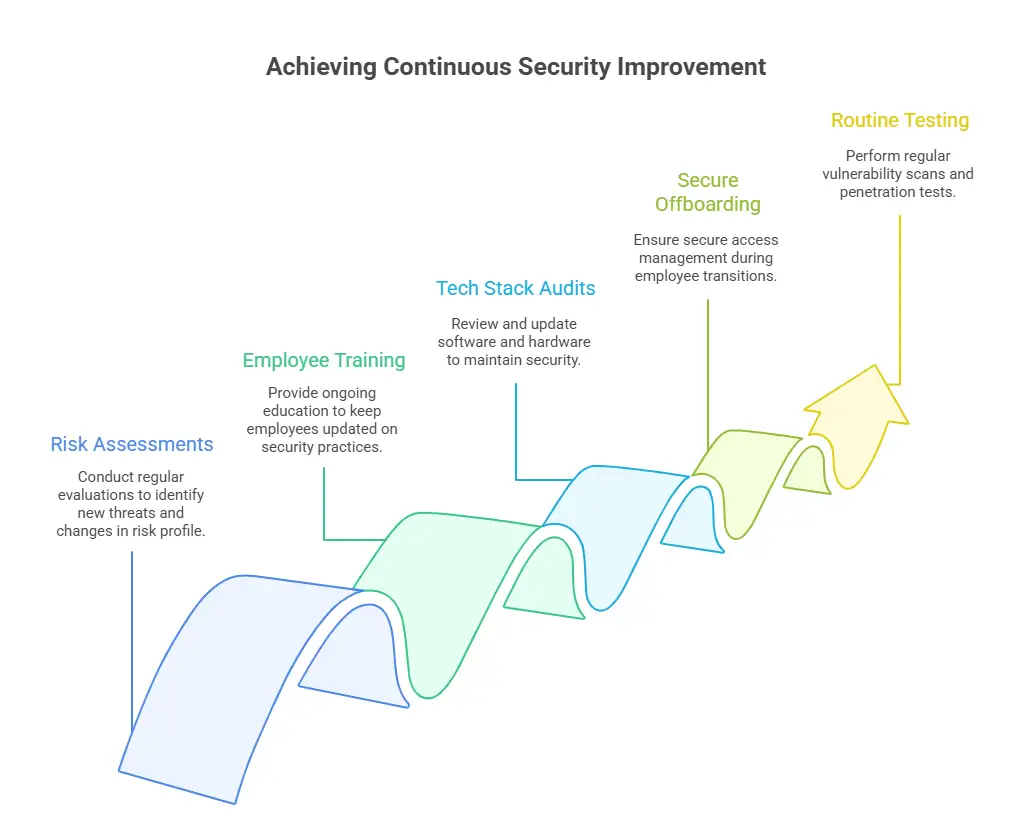
A one-time setup isn’t enough. Security needs to be maintained and improved throughout the year. These activities should be part of your regular cycle.
- Risk assessments every 6–12 months: You need to know if your risk profile changes. Look at new threats, tech changes, and team behavior.
- Ongoing employee training: Refresher courses keep knowledge current. Use short, regular training to prevent fatigue and ease learning.
- Tech stack audits: Review software and hardware annually. Remove or update outdated tools. Replace insecure apps with safer options.
- Secure offboarding and onboarding: Ensure new hires only get required access. Remove access quickly when employees leave.
- Routine testing of controls: Run quarterly vulnerability scans and annual penetration tests. Document your findings and update systems as needed.
Information Security Strategy Example Based on ISO 27001
ISO 27001 provides a clear framework for how to build a strong strategy. Here’s what a simplified plan looks like in real life.
- Asset Discovery and Classification: List all devices, apps, systems, and data repositories. Group them by value, exposure, and risk.
- Risk Assessment: Run a formal assessment to rank risks. Use scores like likelihood and impact. Prioritize the top 5 risks for immediate action.
- Employee Awareness: Launch basic awareness training in month one. Start phishing simulations in month two. Add reporting drills by month four.
- Security Controls Apply controls from Annex A of ISO 27001. These include access controls, secure coding, and mobile device use.
- Regular Review: Use metrics such as MTTR (Mean Time to Recovery), number of critical incidents, and CSAT scores from employees and customers.
Governance Roles and Responsibilities for Security Success
A successful information security strategy plan needs clear accountability. Everyone must understand their role in protecting data and systems. This is where many plans fall short.
Below is a table to help define key roles and who is responsible for each part of the strategy.
| Role | Responsibility |
| CEO / Executives | Approve strategy and allocate resources |
| Head of IT | Build and maintain the security program |
| IT Team Leads | Implement technical controls and monitor assets |
| HR Manager | Coordinate training and onboarding policies |
| Legal / Compliance | Ensure regulatory alignment and audit prep |
| All Employees | Follow policies and report suspicious activity |
Strengthen Your Information Security Strategy With Prototype IT
Building an information security strategy plan takes more than a checklist. You need clear objectives, tested controls, and a partner who brings structure and experience to the table. Most internal teams can’t manage that alone.
Prototype IT helps SMBs design and implement scalable, policy-driven security strategies that support long-term growth.
We resolve over 82% of support requests on the first try. We also maintain a CSAT rating above 97.5%, showing how seriously we take every client’s success.
| Ask Our Texas-Based Team How You Can Prevent Data Breaches | ||
| Dallas | Lewisville | Fort Worth |
Contact us today to get a full review of your current plan and expert help to strengthen it for the future.
Free Network Assessment:
Get In Touch
- ▶ 401 E. Corporate Dr STE 220
Lewisville, TX 75057 - ▶ 600 W. 6th St Suite 485
Fort Worth, TX 76102 - ▶ 13155 Noel Rd Suite 905
Dallas, TX 75240 - Phone: (214) 270-0850
- Web: https://www.prototypeit.net
