
What You Can Do to Prevent Cyber Vandalism
December 25, 2024



Cyber vandalism refers to deliberate actions that intend to damage, disrupt, or deface digital assets, systems, or networks. These actions are not necessarily driven by financial gain, although sometimes they are.
| “Cyber vandalism may seem like less of a threat compared to other types of attacks, but the damage it can cause can still cost your business a significant amount of time and money to clean up.” – Thad Siwinski, CEO of Prototype IT |
Generally, the cyber vandalism definition is based on the intent of the enactor. While other types of cyber attacks intend to steal sensitive information, cyber vandals are more focused on simply causing inconveniences or reputational damage.
However, cyber vandalism may also be a precursor to a more serious attack. Hackers will sometimes commit acts of cyber vandalism as a type of “trial run” to test your system’s defenses before they fulfill their true intention.
For these reasons and more, you need to make yourself aware of what cyber vandalism attacks are and how they work. Understanding the effects of cyber vandalism and how enactors perform these attacks will help you defend yourself against them.
What’s The Difference Between Cyber Vandalism, Data Vandalism, & Electronic Vandalism?
The difference between these 3 types of digital vandalism is the target of the attack. Cyber vandalism disrupts online platforms and services, data vandalism compromises stored data’s integrity, and electronic vandalism targets both physical and digital components of electronic systems.
To demonstrate the difference, here is an example scenario that would represent each.
| Cyber Vandalism | A company’s website displays offensive images after hackers break in and deface the homepage. Visitors trying to access the site see these images instead of the usual content. |
| Data Vandalism | An attacker intentionally edits customer records in the company database by changing phone numbers and deleting addresses. When customers call for support, the staff struggles to find accurate information. |
| Electronic Vandalism | Someone breaks into an office and smashes several servers with a hammer. |
7 Types of Cyber Vandalism & How to Reduce Your Risks
1. Distributed Denial of Service (DDoS) Attacks
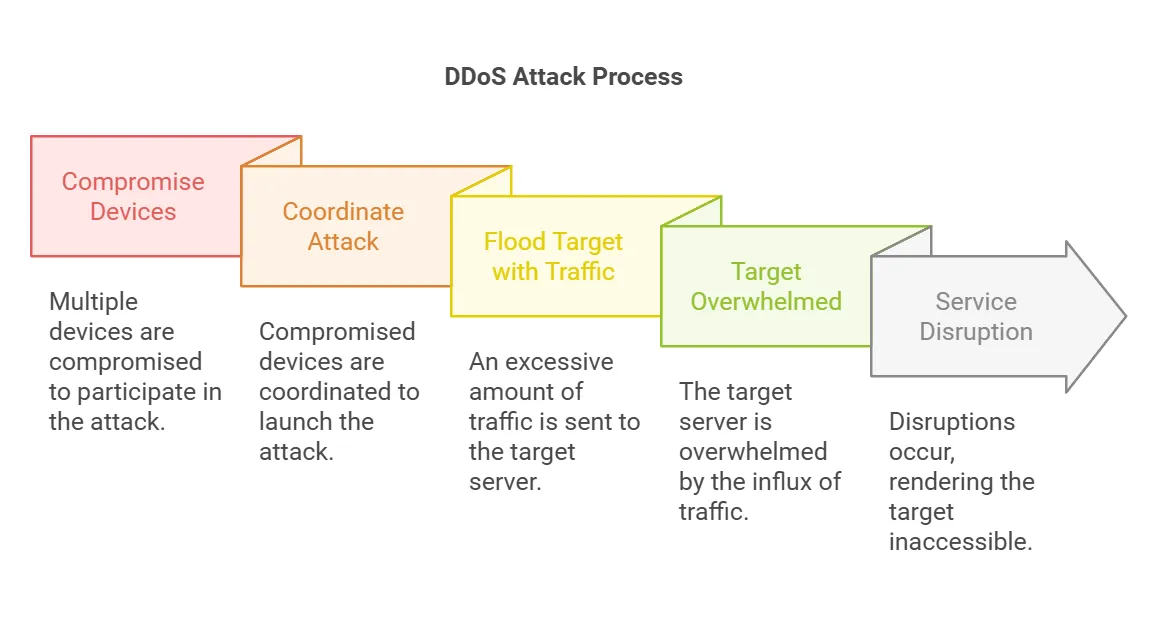
A DDoS attack overwhelms a website or network with traffic to make it unavailable to users. Hackers often use botnets, which are groups of infected devices, to flood the target. This type of attack can shut down online services and disrupt your business workflow.
As technology gets more sophisticated, these attacks become more damaging. The length of time that it takes to resolve a DDoS attack has increased by 400% since 2022. The good news is that you can protect your computer systems by using firewalls, network monitoring tools, and traffic filtering services.
2. SQL Injection
SQL injection exploits vulnerabilities in website databases. Attackers insert malicious code into input fields, like login pages. This technique can lead to leaked data, altered records, or website defacement. Prevent SQL injection by validating all user input, using parameterized queries, and performing regular software updates.
Get 24/7 Eyes on Your IT NetworkSo you can stop malicious code at its injection site. |
3. Cross-Site Scripting (XSS)
XSS attacks inject malicious scripts into trusted websites. These scripts execute in a user’s browser, allowing attackers to steal session cookies or impersonate the victim. This can lead to account compromise or data theft. Prevent XSS attacks by sanitizing user input, using secure coding practices, and applying security patches.
4. Website Defacement
Website defacement happens when cyber vandals hack into a business’s website and replace its content with offensive messages, propaganda, or false claims. This can damage the company’s reputation and erode customer trust. Prevent defacement by using strong passwords, securing administrative access, and keeping software up to date.
Additionally, 55% of website defacements are re-defacements. That means that if your website is targeted once, there is a high chance that you will be targeted again.
5. Data Poisoning
Cyber vandals may corrupt public datasets or community-driven platforms by entering false or misleading information. This compromises the reliability of these shared resources. Avoid this by restricting editing permissions, tracking changes, and setting up approval processes for modifications.
Data poisoning is also a risk if your organization uses AI tools for any business process. Although the cyber vandals may not target your business directly, they will affect your operations if they vandalize a large AI tool that you use. AI systems that work using a poisoned dataset show a 15% degradation in performance. Poisoners are also rarely caught due to the subtle nature of the attack.
For that reason, you may want to avoid relying on a single AI vendor or tool to minimize possible operational disruptions. Also, use complementary tools to validate critical AI-generated insights.
| Learn More About How You Can Avoid a Data Breach |
6. Social Media Account Hijacking
Attackers may take control of a business’s social media accounts and post offensive, misleading, or damaging content. This can harm the company’s reputation, confuse customers, and lead to financial losses.
They may gain access through phishing, weak passwords, or compromised devices. Protect accounts by using strong, unique passwords, enabling multi-factor authentication, and monitoring account activity for unusual behavior.
7. Digital Graffiti
Digital graffiti involves hackers tagging or vandalizing online spaces like forums, public profiles, or virtual environments with disruptive or inappropriate content. This can include offensive language, images, or spam. To prevent this, implement moderation tools, use CAPTCHA to block bots, and limit permissions for user-generated content.
| Let Cybersecurity Experts in Texas Protect You From Cyber Vandalism | |
| Dallas | Fort Worth |
Prevent Cyber Crime of All Kinds By Working With IT Specialists
Your first step to preventing cyber vandalism is to prevent unauthorized access to your computer systems. That’s why you need a team to implement zero-trust security and IDP strategies to protect your precious data.
Prototype IT’s team is capable of both. We can also help you reduce your risk of social engineering by preventing the phishing emails that can fool your employees. With fewer potential entry points, vandals will have fewer opportunities to deface your IT.
Reach out today to get started.
Free Network Assessment:
Get In Touch
- ▶ 401 E. Corporate Dr STE 220
Lewisville, TX 75057 - ▶ 600 W. 6th St Suite 485
Fort Worth, TX 76102 - ▶ 13155 Noel Rd Suite 905
Dallas, TX 75240 - Phone: (214) 270-0850
- Web: https://www.prototypeit.net
